05.07.2026 | News, Featured Homepage, Custom Products, Swag, Why Stran, 2026
How to Use Branded Merch to Warm Up Cold Leads
Cold outreach has a problem. Inboxes are fuller than ever, LinkedIn connection requests go unanswered, and the follow-up email sequence that used to move deals forward now mostly generates polite silence.
The playbook that worked five years ago is producing diminishing returns, and sales and marketing teams know it. The question isn't whether something needs to change. It's what to replace it with.
One answer has been sitting in plain sight: something physical.
Branded merch warms up cold leads by creating a physical touchpoint that interrupts digital noise, signals intentionality, and gives sales teams a natural reason to follow up.
Unlike email, a well-chosen promotional product arrives in the physical world, gets noticed, and stays, shifting the conditions for a conversation rather than competing for inbox attention.
Why Does Merch Help Warm Up Cold Leads?

There's a fundamental difference between a message that lives in someone's inbox and an object that lands on their desk. Digital outreach competes with hundreds of other inputs for a few seconds of attention, but a well-chosen piece of branded merch doesn't compete with anything. It arrives in the physical world, gets picked up, gets noticed, and stays.
The data backs this up. According to ASI's 2026 Ad Impressions Study, nearly 80% of consumers report a more favorable view of a brand after receiving a promotional product, and three in four say it makes them more likely to do business with that company.
Why does merch help warm leads? It’s tangible.
A physical object requires a physical response: someone has to pick it up, open it, and decide what to do with it. That moment of engagement is one that no email can manufacture.
The Difference Between a Merch Gift and a Sales Strategy
Here's where most merch-as-outreach efforts fall apart: the send itself isn't the strategy. A branded pen dropped in the mail to a cold contact isn’t enough to get a conversation going. The key to moving the needle is relevance, timing, and intent.
Consider a post-conference follow-up: your team just spent two days at an HR leadership event. You met dozens of people, had real conversations, exchanged cards. The window for follow-up is short, and everyone those contacts met is sending the same email.
Now imagine a small, well-considered kit arrives at their office a week later. It’s something that references a shared moment from the event, reflects their industry, or speaks to a value you know matters to them. Suddenly the follow-up isn't an email they can ignore. It's an object on their desk that reminds them the conversation was worth continuing.
The same logic applies to a post-proposal touchpoint, where a send signals confidence and keeps your name present during a decision window. Or a new fiscal year outreach, timed to when budgets open and buyers are actively evaluating new partnerships. In each case, the merch isn't the message, but rather it's the delivery mechanism for one.
What Should You Send to a Cold Lead?
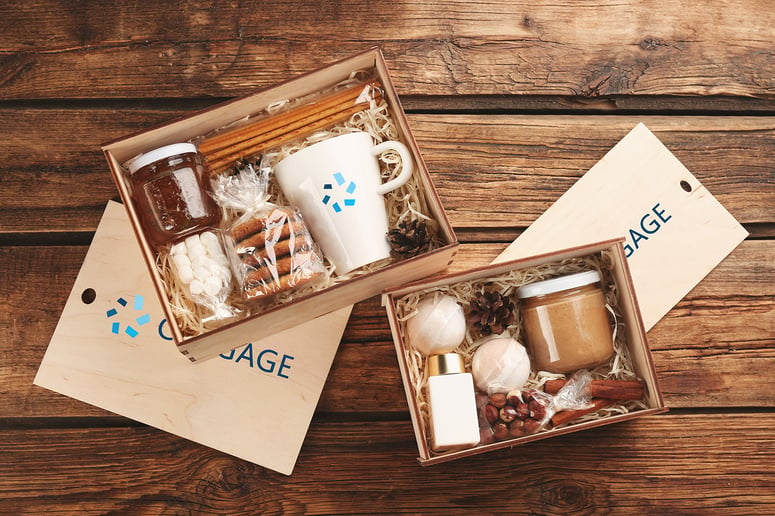
Product selection is where strategy either holds or falls apart. The ASI study is clear that usefulness is the single most important factor in whether someone keeps a promotional item. That means the brief isn't "what will look good with our logo on it?", but "what will this person use on a daily basis?”
For lead-warming contexts specifically, the item should feel considered and personal. It should be portable enough to ship cleanly and arrive intact. It should have high perceived value relative to its actual cost, like a well-made notebook, a quality drinkware piece, or a kit that illustrates someone thought about it and put it together.
What it shouldn't be is an afterthought. A cheap item sent without context doesn't warm a lead, but instead confirms that your outreach is as generic as everyone else's.
Timing & Sequencing: Merch as Part of a Cadence
Merch works best when it's integrated into a broader outreach sequence instead of being deployed as a standalone tactic. The send should have context before it arrives and a clear next step after it does.
A prospect who receives something out of nowhere with no prior touchpoint has no reference frame for it. A prospect who receives something after a meaningful interaction (a conversation, a proposal, a shared event) has every reason to engage with it.
Following up matters just as much as the send. A simple, low-pressure check-in ("just wanted to make sure the package arrived, and happy to connect this week if the timing works") gives you a natural reason to re-enter the conversation without leading with a pitch.
The merch created the opening; the follow-up walks through it.
How To Measure the ROI of Promotional Products for Sales Outreach
There's no straight line from a package to a closed deal, and it's worth being honest about that. What merch-assisted outreach does is shift the conditions; it increases the likelihood that a prospect responds, agrees to a meeting, or stays engaged through a longer decision cycle. The metrics to watch are response rate lift after a send, meeting conversion compared to digital-only outreach, and pipeline stage progression for accounts that received merch versus those that didn't.
The ROI is real. It just doesn't always look like a cost-per-click report.
Warming up a cold lead is about choosing intention and creativity over convenience. Find a way to be memorable at a moment when your prospect has every reason to tune you out, and you’re already ahead of competitors.
Looking for product inspiration for your next outreach program? Check out our latest collection of Sustainable Swag picks!
Frequently Asked Questions
What is the best promotional product to send to a cold lead?
The best promotional products for sales outreach are useful, high perceived value, and easy to ship. Quality drinkware, well-made notebooks, compact tech accessories, and curated kits tend to perform well because they earn a place in someone's daily routine rather than ending up in a drawer.
How do you follow up after sending branded merch to a prospect?
Wait three to five business days for the item to arrive, then send a brief, low-pressure check-in. Something like "just wanted to make sure the package arrived, happy to connect this week if the timing works" gives you a natural reason to re-enter the conversation without leading with a pitch.
Does sending merch actually improve sales conversion rates?
According to ASI's 2026 Ad Impressions Study, nearly 80% of consumers report a more favorable view of a brand after receiving a promotional product, and three in four say it makes them more likely to do business with that company. While there's no straight line from a send to a closed deal, merch-assisted outreach consistently improves response rates, meeting conversion, and pipeline progression compared to digital-only sequences.
When is the right time to send merch during a sales cycle?
The highest-impact moments tend to be immediately after a meaningful first conversation, as a post-conference follow-up, during a post-proposal decision window, or at the start of a new fiscal year when budgets open and buyers are actively evaluating new partners.
Loved this blog? get more insights from our team!
👐 Subscribe to our blog to get the first look at our latest swag collections
🎧 Reach out to our friendly branding experts
More ResourceS
Elevate Your Branded Merch Strategy